location
addressed
auto-generated
maintenance
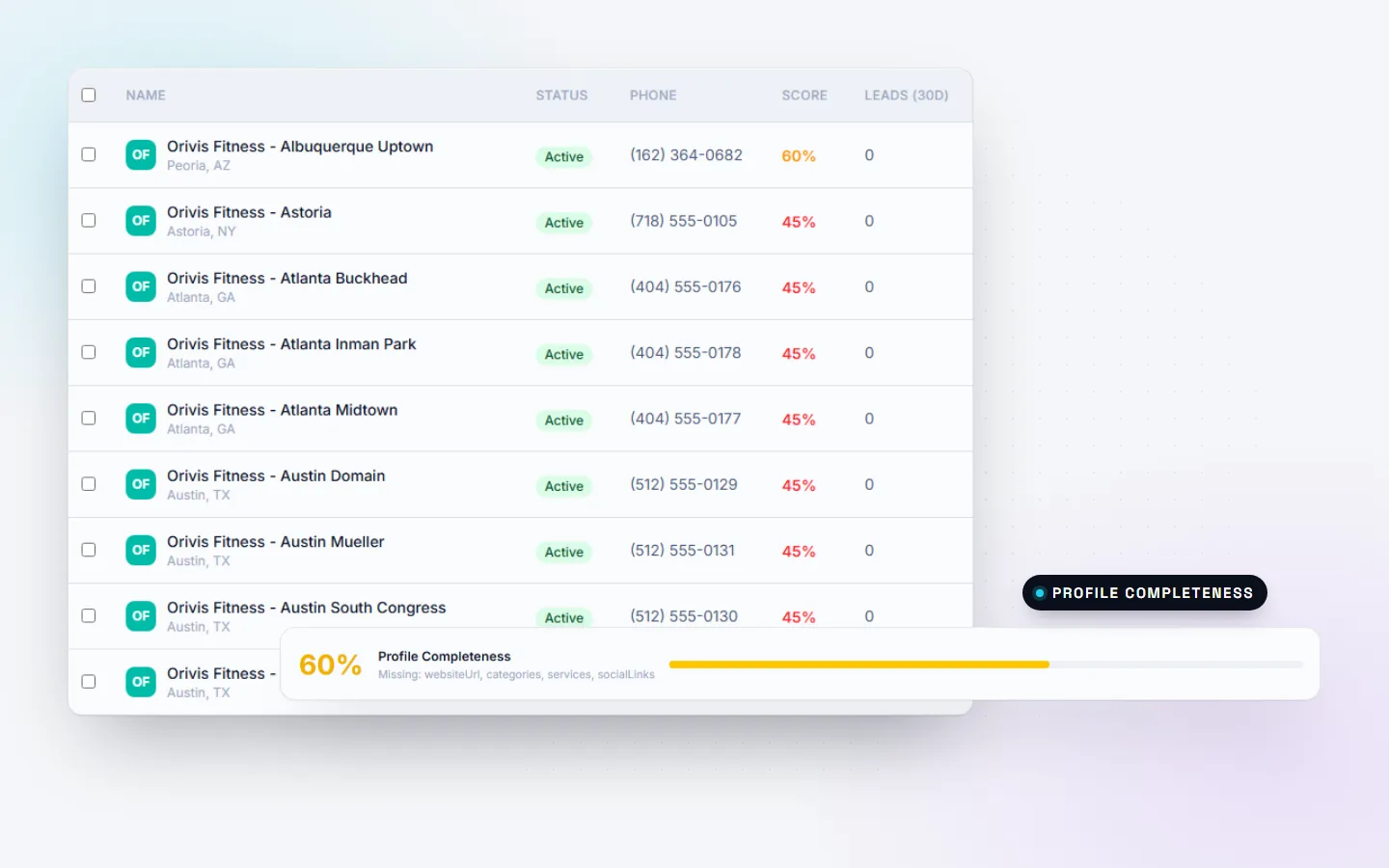
Complete profiles. At a glance, across every location.
KynectLocal tracks profile completeness across every location. Missing data surfaces as a gap, hours, FAQs, coordinates, social links, schema. Complete profiles feed richer structured data, more accurate llms.txt files, and stronger signals for AI engines. No manual audits required.
- →Hours, coordinates, and social profiles checked per location
- →FAQs and schema completeness surfaced as gaps
- →Complete profiles generate richer structured data automatically
- →Network-wide completeness visible from the locations list
llms.txt tells AI what to read and what to trust.
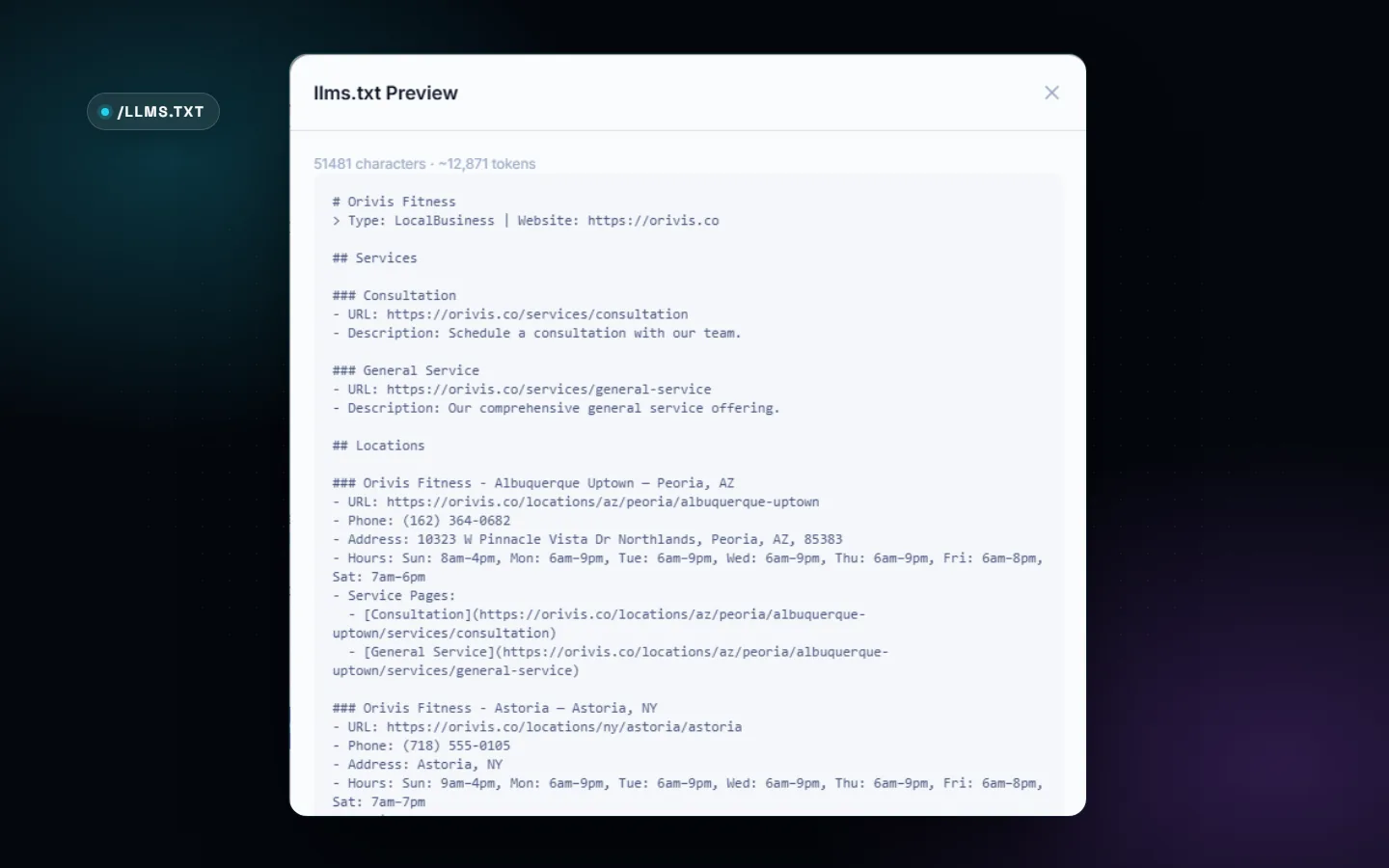
Every location gets its own llms.txt file: a set of directives that tells AI crawlers what your brand wants them to read. Think of it as a briefing document for ChatGPT, Claude, and Perplexity — here's who we are, here's what's authoritative, here's what you can cite. It updates automatically whenever the location profile changes.
- →Generated per location, updated on every profile change
- →Directives for GPTBot, ClaudeBot, PerplexityBot, and Google AI Overviews
- →Canonical content signals for AI citation accuracy
- →No developer required. Pure infrastructure.
Every schema type that matters. Auto-generated. Auto-validated.
KynectLocal generates and validates structured data for every location page automatically. You don't write JSON-LD, you don't manage schema templates, you don't check Google Search Console for errors. It all runs in the background every time a location saves. If something is wrong, it gets blocked before it goes live.
- →LocalBusiness, FAQPage, and AggregateRating auto-generated
- →Offer schema from active promotions
- →Service schema per service page
- →Breadcrumb and SearchAction for search features
- →Schema validated on every publish. Errors blocked before they go live.
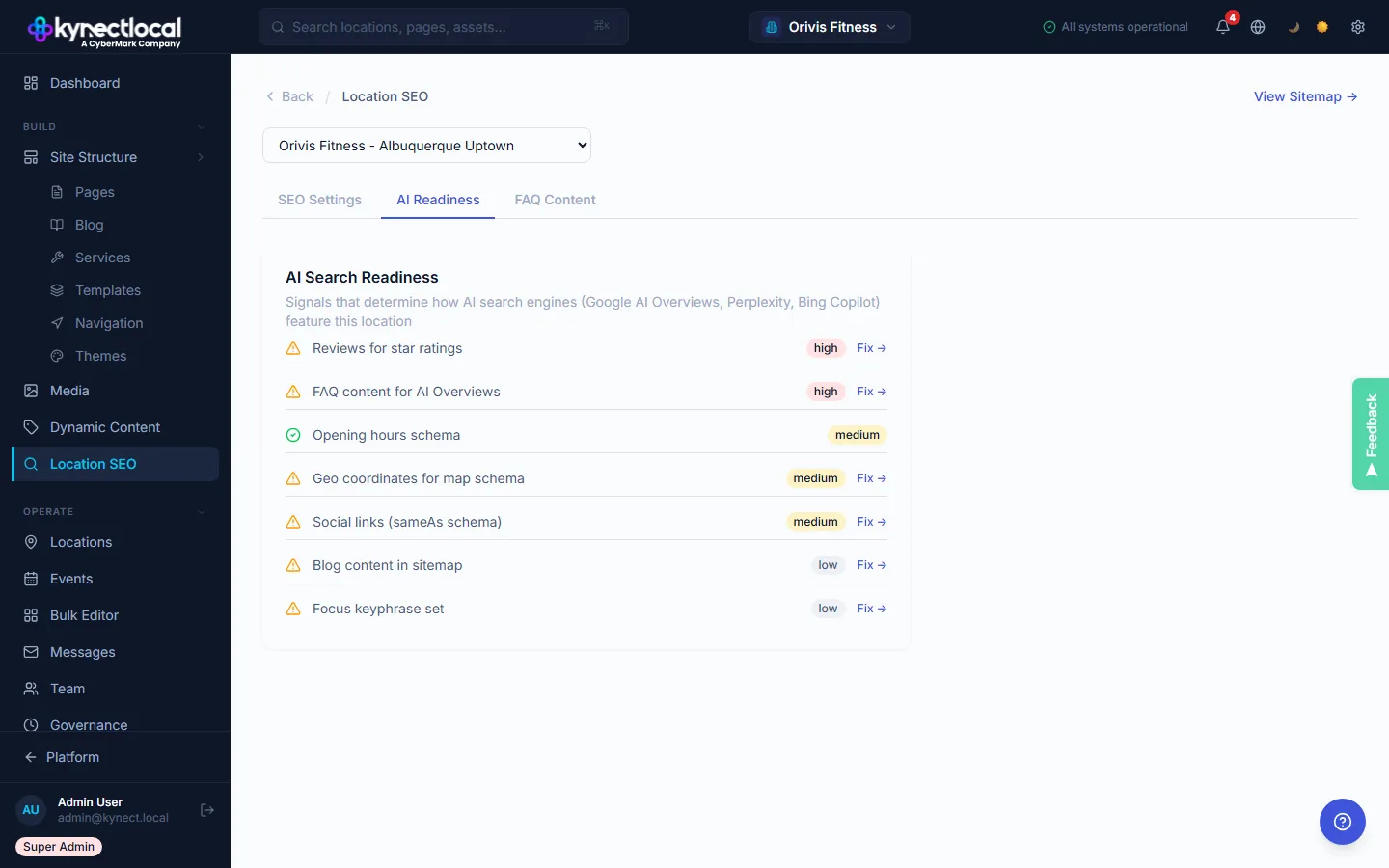
Eight signals.
One score.
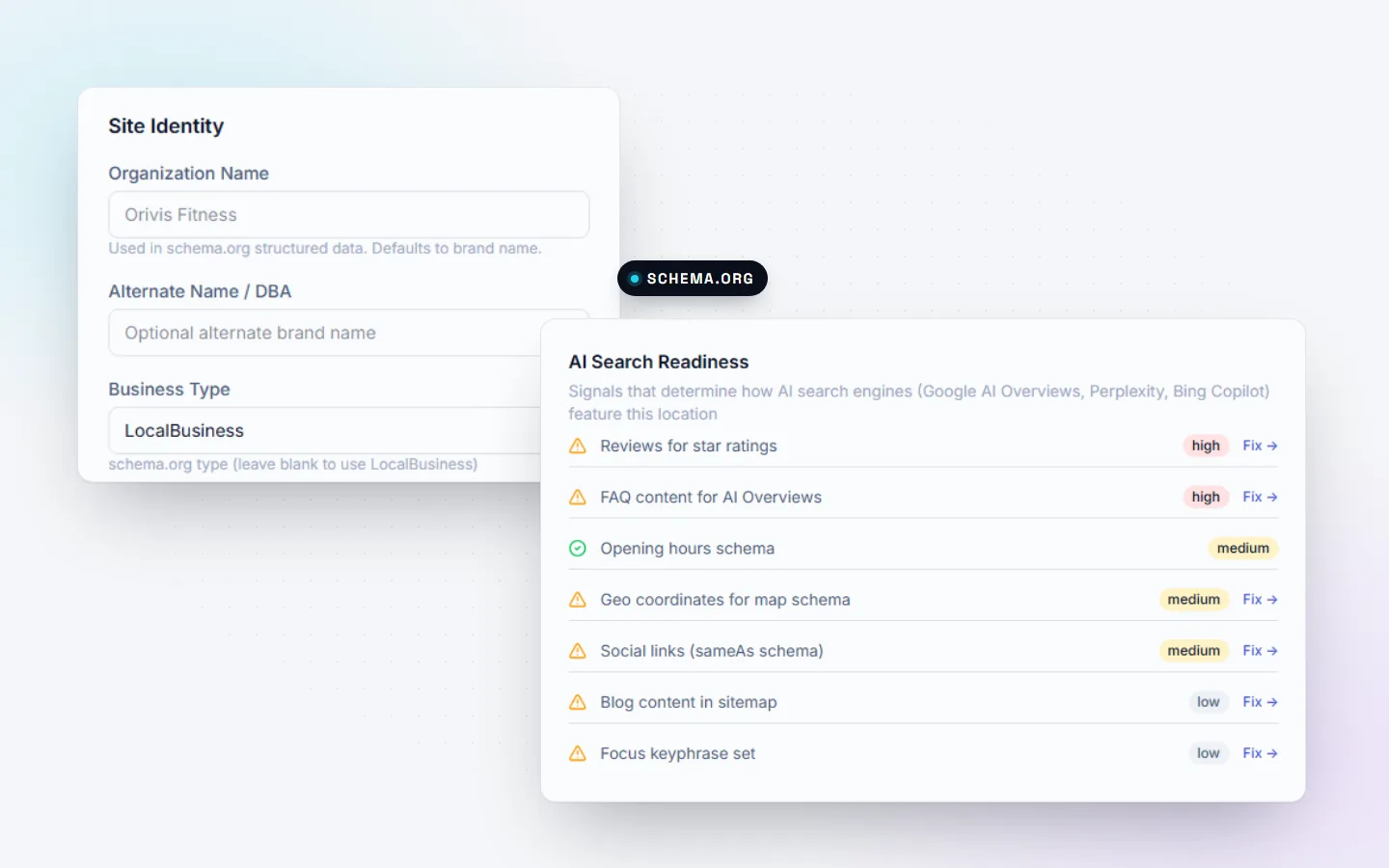
AI engines surface local businesses based on how complete their structured data is. See every gap, fix it instantly.
Missing FAQ schema and recent review data. Fix these to reach 100.
The infrastructure beneath the score
The score is a diagnostic. The infrastructure is what fixes it: automatically, on every save, across every location.
llms.txt auto-generation
Every location gets its own llms.txt file telling AI crawlers what to read and trust. Generated from the location profile, updated on every save. No developer needed, no file to manage, no drift.
Schema infrastructure
LocalBusiness, FAQPage, AggregateRating, Offer, Breadcrumb, SearchAction, and Service schema generated and validated on every publish. No manual JSON-LD, no testing tools, no Search Console errors.
llms.txt, one file AI engines actually read
KynectLocal generates an llms.txt file per location, updated automatically on every profile save. It tells AI crawlers what your brand wants them to read and cite, no developer required.
FAQ schema at scale
FAQs are one of the strongest signals for AI discovery. KynectLocal generates FAQPage schema for every FAQ on a location page: structured, validated, and ready to be cited in AI search responses and Google AI Overviews.
Review schema aggregation
AggregateRating schema pulls review counts and star ratings into the location's structured data, making them visible in Google rich results and surfaced when AI engines answer "best [service] near me" queries.
Your brand, discoverable by every AI that matters.
AI search is a growing network of crawlers indexing the web for natural language queries. KynectLocal generates an llms.txt file per location that identifies your brand to all major AI crawlers. No per-bot configuration required, just a complete, authoritative profile.
Every schema type AI engines rely on.
All generated automatically. All validated before publish. All tied to the location's master profile data.
Score. Fix. Propagate. Repeat.
Score on every change
KynectLocal recalculates the AI readiness score every time a location changes. The 8-signal checklist runs automatically. No manual trigger, no scheduled audit, no waiting for a weekly report.
Gaps surface as recommendations
Low-scoring signals show up as specific action items: "Add FAQs," "Verify coordinates," "Connect social profiles." No diagnostic exercise required. The platform tells you what to fix and where.
Fixes propagate automatically
Save the fix and it goes everywhere at once: schema, llms.txt, crawler directives, and the location website. IndexNow pings search engines within minutes. AI crawlers pick it up on their next visit.
AI visibility is now a measurable brand metric.
- → See AI readiness scores across your entire network. Know which locations are visible to ChatGPT, Perplexity, and Google AI, and which ones aren't showing up at all.
- → Schema is managed at the platform level. No franchisee can accidentally break the structured data that AI engines depend on.
- → llms.txt is controlled at the brand level and deployed per location automatically. Every AI crawler gets consistent, brand-approved signals.
Know exactly where you stand.
- → Your AI readiness score shows exactly which signals need attention. No SEO knowledge required to understand what's missing.
- → Add FAQs, verify your hours, connect your social profiles. Each one improves your score and your visibility in AI search.
- → Schema and llms.txt are handled automatically. You don't need to know what they are. Just know they're keeping your location visible.
Related features
Location SEO
Traditional SEO infrastructure: title tags, meta descriptions, canonical URLs, XML sitemaps, all built on the same location profile data.
Explore →Location Profiles
The master record that feeds all AI readiness signals. Complete profiles produce higher scores. Incomplete profiles have visible gaps.
Explore →Reviews
Review count and recency is one of the 8 readiness signals. Aggregated review schema feeds AggregateRating output across the network.
Explore →See what KynectLocal costs for your network.
Per-location pricing with no seat limits. Build a custom estimate in about two minutes.